Reliable master data synchronization with F24
Orchestra as middleware for data reconciliation and data updating
Critical factor for F24: master data synchronization
Master data synchronization refers to the synchronization and updating of master data between different systems, databases or applications within a company or across company boundaries. In the case of F24, the master data that needs to be synchronized is mainly personal, employee and contact data.
Synchronization between F24 customers’ IT systems and F24’s SaaS solutions (FACT24 ENS+ and CIM) ensures that this data is consistent, correct and up-to-date in all relevant places.
The challenge at F24
F24’s customers rely on being able to use F24’s SaaS solutions to notify the employees and people they want to reach at any time. To ensure that these notifications run smoothly, the master data of the customers served must always be up-to-date, complete and as error-free as possible. Incomplete, outdated or incorrect master data would prevent F24 from providing its customers with trouble-free communication. For this reason, master data is regularly exchanged between the F24 systems and its customers.
However, the most important prerequisite for the smooth functioning of F24’s service portfolio – master data synchronization – also harbors the greatest potential for errors.

Before the introduction of Orchestra, customers had three options for carrying out this master data exchange:
- Manual maintenance of master data
Manual maintenance of data is very error-prone. In addition, care must be taken to ensure that all the places where the data is used are always adjusted when the data is changed. The risk that the data is not consistent and up to date at all relevant points is enormous with this approach. - Using a predefined Excel format
The predefined Excel format makes it possible to import large data sets at once. However, the challenges of the manual procedure still remain and the susceptibility to errors is also present here. - Connection of an API
The “luxury variant” of the three approaches enables master data to be exchanged automatically via a suitable interface. However, the problem here is that the implementation of this solution is the responsibility of the customer, which means that implementation often fails due to a lack of developer capacity.

F24’s requirements for the project
F24 was looking for a software solution that would enable the smooth, fast and scalable exchange of master data with its customers’ various IT systems. It is particularly important that master data from various source systems can be processed in different data formats, if necessary also via special protocols.
In order to work successfully with its customers, F24 must ensure that its solution is compatible with the third-party systems and data records provided by its customers. It was important for F24 that the software met the following requirements:
- Processing of large master data sets in a wide variety of formats such as CSV, XML, JSON, SQL, XLSX…
- Ability to validate, cleanse and enrich master data records
- Determination and transfer of difference data, only changes to master data records should be transferred to reduce the load on ENS/ENS+ systems
- Creation of group and person entities
- Automated generation of error reports
How was the project implemented?
A typical master data integration for an F24 customer looks schematically as follows:
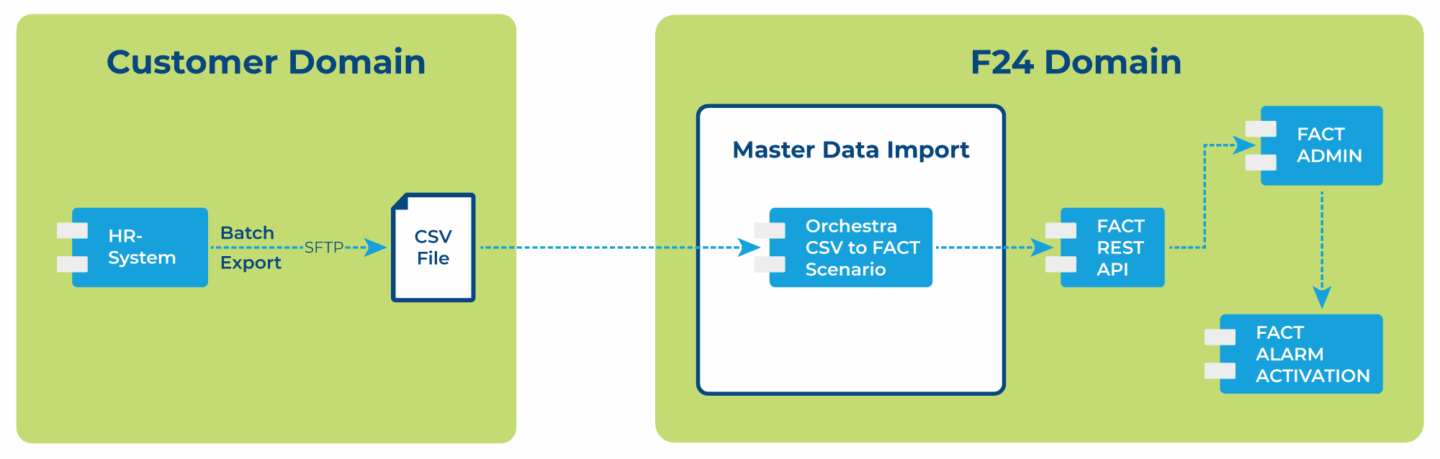
How does a customer project work at F24?
The process in a customer project at F24 in which Orchestra is used is as follows:
- A potential customer provides a data format as an example
- F24 checks whether master data synchronization is possible, based on the question of whether this data format can be processed
- F24 then develops the specifications for an Orchestra scenario and sends these to the soffico development team
- The requirements are usually implemented by the soffico team within a few working days
- After successful implementation, F24 receives the complete solution (scenario) back and can start integration with the customer
Added value through Orchestra as middleware for master data synchronization
As middleware for master data synchronization, Orchestra closes the gap between the simple Excel upload and the complex API integration that F24 customers previously had to handle themselves.
By using Orchestra as middleware, F24 customers can provide their master data in various formats. Orchestra processes this data and imports it directly into the customer accounts so that the data is available within a very short time.
This enables F24 to serve a wider range of customers, as they can easily process a wide variety of data formats and protocols. In addition, the hurdle for new software is reduced if the effort on the customer side does not increase with the new solution.
Orchestra Scenario F24 also offers the following functionalities:

The Orchestra scenario compares the incoming data records with existing ones and only processes the changed data, which saves F24 valuable server capacity
Incorrect or duplicate data records are automatically cleaned up by the Orchestra scenario
If a cleanup is not possible, Orchestra takes over the automatic error handling
After each data synchronization, Orchestra provides a comprehensive report that shows how many data records have been imported, cleansed or updated
Orchestra identifies missing data records and reports them
In addition, data can be assigned and grouped directly during data synchronization
Rica Holzmann