AI agents in established system landscapes
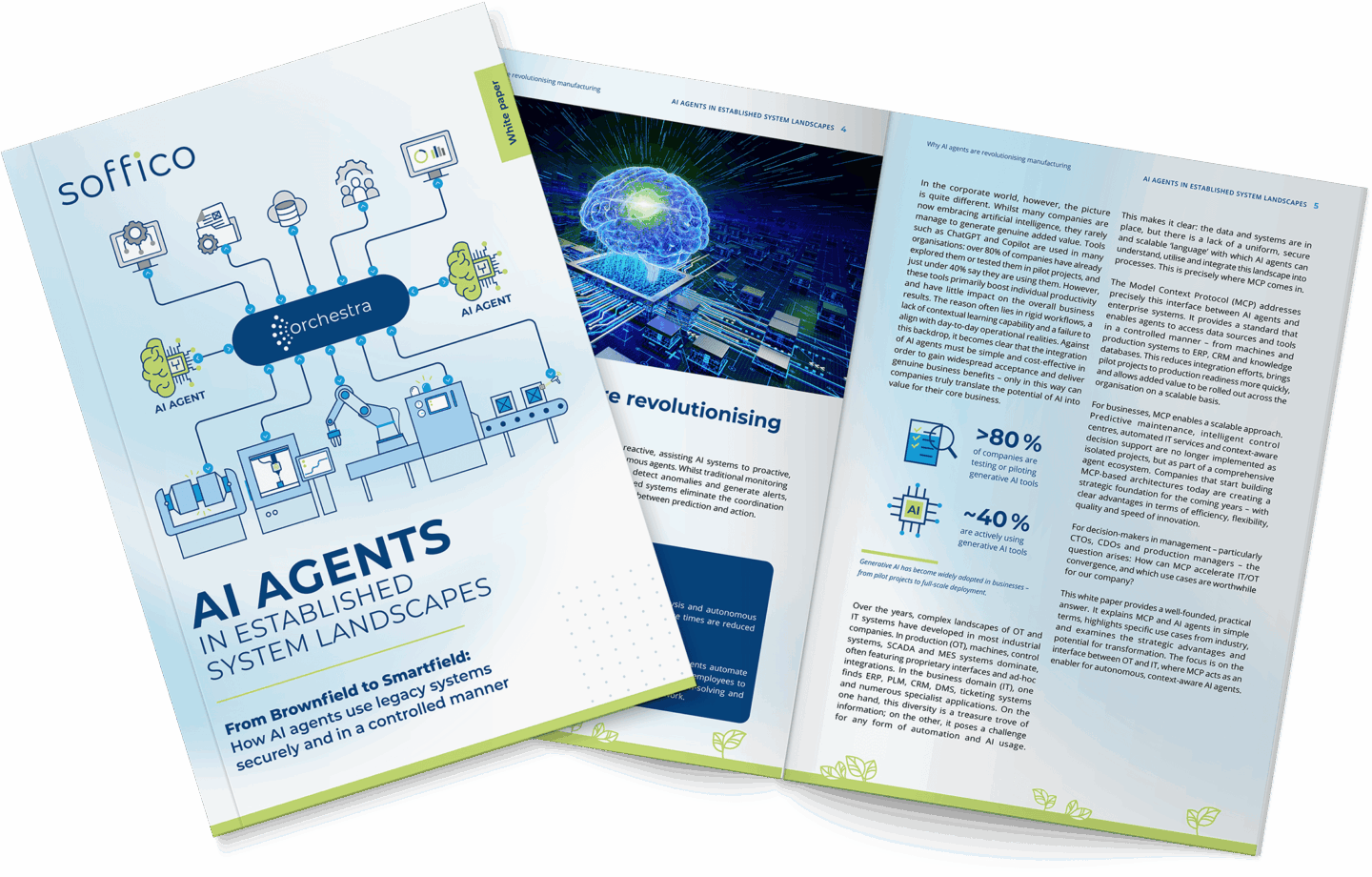
How to use MCP to seamlessly integrate AI agents with IT and OT systems, scale projects and deliver real operational value.
Free of charge. Compact. And featuring specific, practical use cases.
From generative AI to productive AI agents in industry
In industry, AI agents are evolving from mere assistance systems into digital colleagues. They can independently gather information, assess contexts, prepare decisions and trigger actions within business systems. As a result, what was once sporadic AI support is becoming an operational lever for efficiency, quality and responsiveness.
Industrial companies already possess extensive data sets in production, maintenance, IT and business management systems. Nevertheless, the benefits of many current AI solutions remain limited. Although generative AI tools are already being widely tested and deployed, their impact is often confined to isolated productivity gains for individual employees. Sustainable added value for the core business usually only arises when AI not only generates content but also understands processes, prepares decisions and can trigger actions in real-world systems.
This is precisely where AI agents come into their own. The biggest hurdle usually lies not in the intelligence of the models themselves, but in their controlled integration into established IT and OT landscapes comprising ERP, MES, CRM, DMS, ticketing systems, production facilities and other specialist applications. This white paper demonstrates how this challenge can be addressed using MCP as a unified, secure and scalable integration platform.

The Model Context Protocol as a basis for integrating AI agents
The Model Context Protocol, or MCP for short, addresses the key integration challenge between AI agents, data sources and enterprise systems. As an open standard, it establishes a uniform, secure and scalable connection through which agents can access information, resources and functions in a controlled manner.
However, the operational value is not created by the protocol alone. What is crucial is an integration foundation that provides structured access to data sources, processes, access rights and system logic within established IT and OT landscapes. This is precisely where Orchestra comes in: as a standardised software solution for secure, scalable data exchange, soffico positions Orchestra as the foundation for making legacy and brownfield systems agent-ready and making data and processes available to AI agents via MCP.
MCP is thus not merely a technical standard, but a strategic foundation for an enterprise-wide agent ecosystem. In this way, companies create the conditions to integrate AI agents into their value chain not in isolation, but systematically and in a controlled manner.
The key challenges involved in introducing AI agents into industry
The added value of AI agents does not stem solely from powerful models. What matters is whether they can be integrated securely, in a controlled manner and at scale into existing processes, data sources and system landscapes. This is precisely where many industrial companies are currently facing the same challenges.
MCP as the foundation for scalable AI agents
The challenges described show that the benefits of AI agents in industry do not depend solely on the quality of the models. What is far more crucial is whether they can be securely, scalably and controllably integrated with existing IT and OT systems.
This is precisely where MCP comes into its own. As an open standard, it creates a common foundation for connecting AI agents to data sources, applications and processes. This reduces integration efforts, enables use cases to be implemented more quickly and makes it easier to scale successful pilot projects.
For decision-makers in industrial companies, this presents a clear opportunity: Those who establish the prerequisites for MCP-based architectures at an early stage lay the groundwork not only for testing AI agents on a case-by-case basis, but also for integrating them in a controlled manner into operational value creation. MCP is thus not merely a technical enabler, but a key factor for greater efficiency, higher quality, improved responsiveness and faster innovation within mature IT and OT system landscapes.

Dr. Sebastian Heger